Archives for 2014

7 Quick Takes Friday (set #142)

7 Quick Takes Friday

This week: Happy 4th of July! Food City has a wonderful, word-free advertisement for the occasion. We in America (and all the Western world) owe so much. An info-graphic overview of the Supreme Court Hobby Lobby decision. Chris Koch was not aborted: this is how he turned-out. Father Barron takes-on the shallow, anti-religion arguments of Bill Maher. Healthcare for small businesses – how it is working out. Kale…   Jim Gaffigan is strongly opposed! Those who cannot remember the past…

— 1 —

Food City made this wonderful Independence Day commercial. No words spoken, no words needed:

Spotted by Fr. Z

— 2 —

The Becket Fund has a helpful info-graphic to explain the recent Supreme Court Hobby Lobby decision:
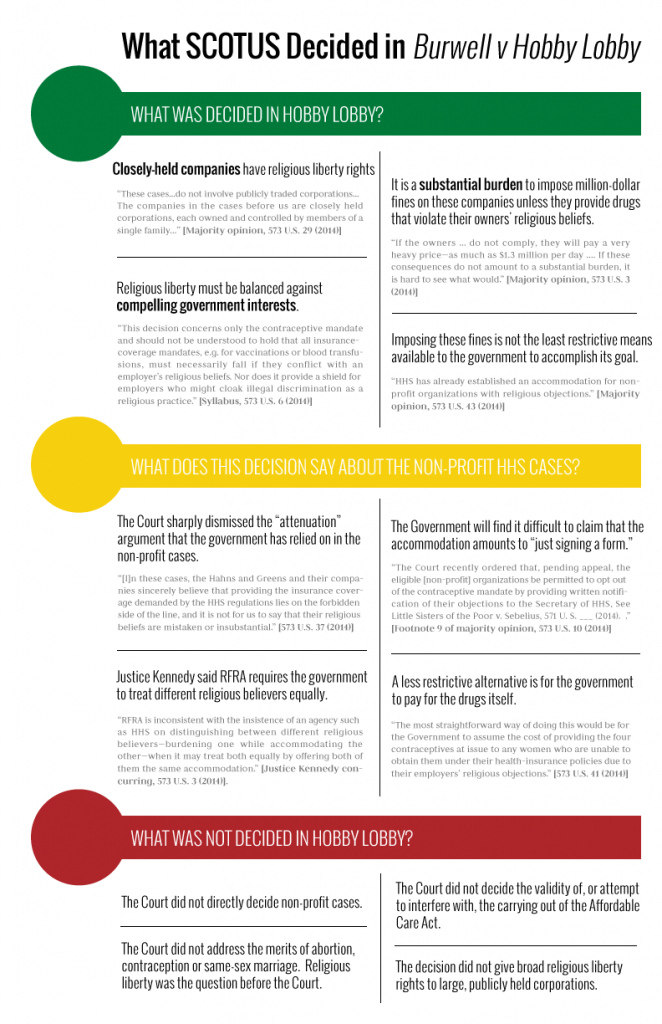
Hobby Lobby Decision

— 3 —

Almost exactly 4 years ago, I wrote about Nick Vujicic in another quick takes item. This week brings a similar story of Chris Koch from Nanton, Alberta. Many believe that people like Nick and Chris should have been aborted. If not, they should live in institutions as completely disabled. How sad.

Spotted by my friend Tom.

— 4 —

Bill Maher specializes in attacking religion. He “mixed it up” recently with Ralph Reed, the founder and former head of the Christian Coalition. Unfortunately, Ralph was ambushed and did not do all that well. Father Barron (who calls Maher “by far the most annoying anti-religionist on the scene today”) picks-up the ball:

— 5 —

The reality of Obamacare is beginning to be felt. As more phases in (carefully scheduled for after the mid-term election, of course), the impact will be felt upon more and more Americans. Here is how it has already impacted one small business trying to do right by their employees:

— 6 —

Where do you stand on Kale? Jim Gaffigan is opposed!

Spotted by Marcel

— 7 —

Those who cannot remember the past are condemned to repeat it (George Santayana).


Some random thoughts or bits of information are worthy of sharing but don’t warrant their own full post. This idea was started by Jennifer Fulwiler at Conversion Diary to address this blogging need. So, some Fridays I too participate when I have accumulated 7 worthy items. Thank you Jen for hosting this project!

Elsewhere: Hobby Lobby wins

Elsewhere

Yesterday the Supreme Court, voting along their usual ideological lines, voted 5-4 in favor of Hobby Lobby. This is wonderful news for religious freedom, but still very far from rolling-back the numerous, unprecedented attacks on it by the current administration.

The good news in the Hobby Lobby decision is that (in at least some circumstances) people do not give up their religious rights simply because they operate a for-profit business. Hobby Lobby is a closely held corporation by a single extended family. The Greens are Protestant Christians who object to abortifacient “contraceptives” (e.g. “Plan B”) in their insurance policies as mandated by Obamacare.

Other cases are not directly effected unless they match the profile of this case. Exactly how closely held a corporation must be or how large it can be before religious freedom rights of its owners evaporate is unclear. Also unclear is how this will effect Catholic owned companies and non-profits who object to paying for any contraception. The Little Sisters of the Poor (for example) might not be helped at all.

As you know, there is little unbiased journalism any more so do not expect to find a completely fair analysis in the mainstream media. The conservative side claims the ruling means more than it does. The liberal side claims the sky is falling with this conservative success in their war on women. For sanity, try not to read what any politician of either side says.

With that disclaimer, Politico has as good coverage as anybody:

The Supreme Court ruled 5-4 in Burwell v. Hobby Lobby on Monday that employers with religious objections can opt out of providing contraception coverage under Obamacare.

The ruling deals directly with only a small provision of Obamacare and will not take down the entire law but it amounts to a huge black eye for Obamacare, the administration and its backers. The justices have given Obamacare opponents their most significant political victory against the health care law, reinforcing their argument that the law and President Barack Obama are encroaching on Americans’ freedoms.

“We doubt that the Congress that enacted [Religious Freedom Restoration Act] – or, for that matter, ACA – would have believed it a tolerable result to put family-run businesses to the choice of violating their sincerely held religious beliefs or making all of their employees lose their existing healthcare plans,” Justice Samuel Alito wrote in the opinion, which was joined by Chief Justice John Roberts and Justices Antonin Scalia, Clarence Thomas and Anthony Kennedy.

The court’s four liberal justices called it a decision of “startling breadth” and said that it allows companies to “opt out of any law (saving only tax laws) they judge incompatible with their sincerely held religious beliefs.”

The court appeared to reject, 7-2, the Obama administration’s argument that for-profit companies cannot assert religious rights under RFRA. Only Justice Sonia Sotomayor joined the portion of Justice Ruth Bader Ginsburg’s dissent that argues companies do not have such rights. Justices Stephen Breyer and Elena Kagan did not join that section and did not explicitly state their views on the point.

The decision could open the door to other closely held corporations seeking to withhold coverage for other medical procedures at odds with firm religious beliefs. It marks the first time that the Supreme Court has allowed companies the ability to declare a religious belief – a decision that could reverberate far past the Affordable Care Act to other laws and issues.

In the short term, the ruling appears to allow the owners of Hobby Lobby and Conestoga Wood Specialties to opt out of the health care law’s requirement that they provide all Food and Drug Administration-approved forms of birth control in their health plans.

Read the whole piece: SCOTUS sides with Hobby Lobby on birth control.

To get a sense of (completely unwarranted) panic of the left, The Federalist has collected tweets in 6 Stupid Arguments About Hobby Lobby From Dumb Liberals. Obviously not an unbiased piece, but the tweets are quoted verbatim.

Baltimore Catechism: 7th to 10th commandments

Baltimore Catechism

Lesson 34

373 Q. What is the Seventh Commandment?
A. The Seventh Commandment is: Thou shalt not steal.

Stealing is one of those vices of which you have to be most careful. Children should learn to have honest hearts, and never to take unjustly even the smallest thing; for some begin a life of dishonesty by stealing little things from their own house or from stores to which they are sent for goods. A nut, a cake, an apple, a cent, etc., do not seem much, but nevertheless to take any of them dishonestly is stealing. Children who indulge in this trifling thievery seldom correct the habit in after life and grow up to be dishonest men and women. How do you suppose all the thieves now spending their miserable lives in prison began? Do you believe they were very honest – never having stolen even the slightest thing – up to a certain day, and at once became thieves by committing a highway robbery? No; they began by stealing little things, then greater, and kept on till they made stealing their business and thus became professional thieves. Again, the little you steal each day does not seem much at the time, but if you put all the “littles” together you may soon have something big, and almost before you know it – if you intend to continue stealing – you may have taken enough to make you guilty of mortal sin. If you intended to steal, for instance, only a small amount every day for the whole year, you would at the end have stolen a large amount and committed a mortal sin. There are many ways of violating the Seventh Commandment. Workmen who do not do a just day’s work, or employers who cheat their workmen out of wages earned; merchants who charge unjust prices and seek unjust profits; dealers who give light weight or short measure or who misrepresent goods; those who speculate rashly or gamble with the money of others, and those who borrow with no intention or only slight hope of being able to pay back, all violate this Commandment. You violate it also by not paying your just debts or by purchasing goods that you know you will never be able to pay for. Moreover, besides the injustice, it is base ingratitude not to pay your debts when in your power to do so. The one who trusted or lent you helped you in your need and did you a great favor, and yet when you can you will not pay, and what is worse, frequently abuse and insult him for asking his own. Though such dishonest and ungrateful persons may escape in this world, they will not escape in the next, for Almighty God will make them suffer for the smallest debt they owe.

Again, others often suffer for the dishonesty of those I have mentioned, for when some good person who really intends to pay is in great need and wishes to borrow or be trusted, he is refused because others have been dishonest. Everyone should pay his debts, and even keep from buying things that are not really necessary till he is thus enabled to pay what he owes. You must pay your just debts even before you can give anything in charity.

374 Q. What are we commanded by the Seventh Commandment?
A. By the Seventh Commandment we are commanded to give to all men what belongs to them and to respect their property.

“Respect their property” – that is, acknowledge and respect their rights to their property and do nothing to violate these rights.

375 Q. What is forbidden by the Seventh Commandment?
A. The Seventh Commandment forbids all unjust taking or keeping what belongs to another.

“Taking,” either with your own hands or from the hands of another; for the one who willingly and knowingly receives from a thief the whole or part of anything stolen becomes as bad as the thief. Even if you only help another to steal, and receive none of the stolen goods, you are guilty. There are several ways of sharing in the sin of another; namely, by ordering or advising him to do wrong; by praising him for doing wrong and thus encouraging him; by consenting to wrong when you should oppose it – for instance, a member of a society allowing an evil act to be done by the society when his vote would prevent it; again, by affording wrongdoers protection and means of escape from punishment for their evil deeds. This does not mean that we should not defend the guilty. We should defend them, but should not encourage them to do wrong by offering them a means of escape from just punishment. We share in another’s sin also by neglecting to prevent his bad action when it is our duty to do so. For example, if a police officer paid for guarding your property should see a thief stealing it and not prevent him, he would be as guilty as the thief. Your neighbor indeed might warn you that the thief was stealing your goods, but he would not be bound in justice to do so, as the officer is, but only in charity, because it is not his duty to guard your property. Parents who know that their children steal and do not prevent them or compel them to bring back what they stole, but rather encourage them by being indifferent, are guilty of dishonesty as well as the children, and share in their sins of theft. But suppose you did not know the thing was stolen when you received it, but learned afterward that it was, must you then return it to the proper owner? Yes; just as soon as you know to whom it belongs you begin to sin by keeping it. But suppose you bought it not knowing that it was stolen, would you still have to restore it? Yes, when the owner asks for it, because it belongs to him till he sells it or gives it away. If you have bought from a thief you have been cheated and must suffer the loss. Your mistake will make you more careful on the next occasion. Suppose you find a thing, what must you do? Try to find its owner, and if you find him give him what is his, and that without any reward for restoring it, unless he pleases to give you something, or unless you have been put to an expense by keeping it. If you cannot find the owner after sincerely seeking for him, then you may keep the thing found. But suppose you kept the article so long before looking for the owner that it became impossible for you to restore it to him, either because he had died or removed to parts unknown during your delay – what then? Then you must give the article or its value to his children or others who have a right to his goods; and if no one who has such a right can be found, you must give it to the poor, for you have it unjustly – since you did not look for the owner when it was possible to find him – and therefore cannot keep it.

376 Q. Are we bound to restore ill-gotten goods?
A. We are bound to restore ill-gotten goods, or the value of them, as far as we are able; otherwise we cannot be forgiven.

“Ill-gotten” – that is, unjustly gotten. “Value.” It sometimes happens that persons lose or destroy the article stolen, and therefore cannot return it. What must be done in such cases? They must give the owner the value of it. However, when you have stolen anything and have to restore it, you need not go to the owner and say, “Here is what I stole from you.” It is only necessary that he gets what is his own or its value. He need not even know that it is being restored to him, unless he knows you stole it; and then it would be better for your own good name to let him know that you are making amends for the injustice done. Therefore, no one need have any excuse for not restoring what he has unjustly, because he has only to see that it is returned in some way to its owner, or to those who have the next right to it, or to the poor. But you must remember you cannot make restitution by giving to the poor if you can restore to the proper owner. You must restore by giving to the poor only when the owner cannot be found or reached. Some persons do not like the duty of restoring to the proper owner, and think they satisfy their obligation by giving the ill-gotten goods to the poor; but they do not. You cannot give even in charity the goods of another without being guilty of dishonesty. If you wish to be charitable, give from your own goods. It is a sin to delay making restitution after you are able to restore. You must restore just as soon as you can, because the longer you keep the owner out of his property and its benefits, the greater the injury you do him and the greater the sin. One who, after being told by his confessor to make restitution, and promising to do so, still delays or keeps putting off, runs the risk of being guilty of sacrilege by receiving the Sacraments without proper dispositions. But suppose a person cannot restore; suppose he lost the thing stolen and has not the value of it. What must he do? He must have the firm resolution of restoring as soon as he possibly can; and without this good resolution he could not be absolved from his sins – even if he had not the real means of restoring. The good intention and resolution will suffice till he has really the means; but this intention must be serious, otherwise there will be no forgiveness.

377 Q. Are we obliged to repair the damage we have unjustly caused?
A. We are bound to repair the damage we have unjustly caused.

378 Q. What is the Eighth Commandment?
A. The Eighth Commandment is: Thou shalt not bear false witness against thy neighbor.

Either in a court, while we are acting as witnesses, or by telling lies about him at any other time.

379 Q. What are we commanded by the Eighth Commandment?
A. We are commanded by the Eighth Commandment to speak the truth in all things, and to be careful of the honor and reputation of everyone.

“Reputation.” If it be a sin to steal a man’s money, which we can restore to him, it is certainly a much greater sin to steal his good name, which we can never restore, and especially as we have nothing to gain from injuring his character. It is a sin to tell evil things about another – his sins, vices, etc. – even when they are true. The only thing that will excuse us from telling another’s fault is the necessity to do so in which we are placed, or the good we can do to the person himself or others by exposing faults. How shall you know when you have injured the character of another? You have injured another’s character if you made others think less of him than they did before. If you have exposed some crime that he really committed, your sin is called detraction; if you accuse him of one he did not commit, your sin is calumny; and if you maliciously circulate these reports to injure his character, your sin is slander. But how shall you make reparation for injuring the character of another? If you have told lies about him, you must acknowledge to those with whom you have talked that you have told what was untrue about him, and you must even compensate him for whatever loss he has suffered by your lies: for example, the loss of his situation by your accusing him of dishonesty. But if what you said of him was true, how are you to act? At every opportunity say whatever good you can of him in the presence of those before whom you have spoken the evil.

380 Q. What is forbidden by the Eighth Commandment?
A. The Eighth Commandment forbids all rash judgments, backbiting, slanders, and lies.

“Rash judgment” – that is, having in your mind and really believing that a person is guilty of a certain sin when you have no reason for thinking so, and no evidence that he is guilty. “Backbiting” – that is, talking evil of persons behind their backs. You would not like your neighbor to backbite you, and you have no right to do to him what you would not wish him to do to you. Besides, everyone hates and fears a backbiter; because as he brings to you a bad story about another, he will in the same manner bring to someone else a bad story about you. It is certainly an honor to be able to say of a person: “He never has a bad word of anyone”; while on the other hand, he must be a despicable creature who never speaks of others except to censure or revile them. Never listen to a backbiter, detractor, or slanderer – it is sinful. Another way of injuring your neighbor is revealing the secrets he has confided to you. You will tell one friend perhaps and caution him not to repeat it to another; but if you cannot keep the secret yourself, how can you expect others to keep it? Again you may injure your neighbor by reading his letters without his consent when you have no authority to do so. This is considered a crime in the eyes even of the civil law, and anyone who opens and reads the letters of another can be punished by imprisonment. It is a kind of theft, for it is stealing secrets and information that you have no right to know. It is dishonorable to read another’s letter without his consent, even when you find it open. To carry to persons the evil things said about them by others so as to bring about disputes between them is very sinful. The Holy Scripture (Rom. 1:29) calls this class of sinners whisperers, and says that they will not enter into Heaven – that is, as long as they continue in the habit. If ever, then, you hear one person saying anything bad about another, never go and tell it to the person of whom it was said. If you do, you will be the cause of all the sin that follows from it – of the anger, hatred, revenge, and probably murder itself, as sometimes happens.

*381 Q. What must they do who have lied about their neighbor and seriously injured his character?
A. They who have lied about their neighbor and seriously injured his character must repair the injury done as far as they are able, otherwise they will not be forgiven.

382 Q. What is the Ninth Commandment?
A. The Ninth Commandment is: Thou shalt not covet thy neighbor’s wife.

383 Q. What are we commanded by the Ninth Commandment?
A. We are commanded by the Ninth Commandment to keep ourselves pure in thought and desire.

384 Q. What is forbidden by the Ninth Commandment?
A. The Ninth Commandment forbids unchaste thoughts, desires of another’s wife or husband, and all other unlawful impure thoughts and desires.

*385 Q. Are impure thoughts and desires always sins?
A. Impure thoughts and desires are always sins, unless they displease us and we try to banish them.

386 Q. What is the Tenth Commandment?
A. The Tenth Commandment is: Thou shalt not covet thy neighbor’s goods.

“Covet” means to long for or desire inordinately or unlawfully. If I should desire, for example, my friend to be killed by an accident, in order that I might become the owner of his gold watch, I would be coveting it. But if I desired to have it justly – that is, to be able to purchase it, or another similar to it, that would not be covetousness.

387 Q. What are we commanded by the Tenth Commandment?
A. By the Tenth Commandment we are commanded to be content with what we have, and to rejoice in our neighbor’s welfare.

388 Q. What is forbidden by the Tenth Commandment?
A. The Tenth Commandment forbids all desires to take or keep wrongfully what belongs to another.

Bread of Life

Bread Of Life

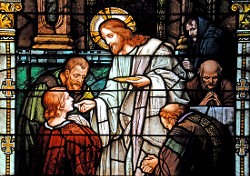
St. John tells us in chapter 6 of a very special time in the ministry of Jesus. Our Lord’s public ministry was at a peak. He was a superstar, for a while, then some might say that He had something of a PR disaster.

The chapter opens with a large crowd of disciples following our Lord. Scripture tells us there were 5,000 men – a large number by any measure, but with their families may have numbered several times that in total. As you know, they all “had their fill” from only 5 loaves of barley bread and 2 fish. Even so, these were not depleted but expanded in abundance to 12 baskets of left-overs. The people wanted to make Jesus king!

Later that night, the Apostles witnessed Jesus walking on the water 4 miles from shore.

Superstar!

Then, as recorded beginning in verse 22, everything took a dramatic turn. It begins with the crowds finding our Lord in Capernum and asking how he got there. They were eager to follow him and be fed.

“Amen, amen, I say to you, you are looking for me not because you saw signs but because you ate the loaves and were filled. Do not work for food that perishes but for the food that endures for eternal life, which the Son of Man will give you. For on him the Father, God, has set his seal.” So they said to him, “What can we do to accomplish the works of God?” Jesus answered and said to them, “This is the work of God, that you believe in the one he sent.” So they said to him, “What sign can you do, that we may see and believe in you? What can you do? Our ancestors ate manna in the desert, as it is written:

‘He gave them bread from heaven to eat.'”

So Jesus said to them, “Amen, amen, I say to you, it was not Moses who gave the bread from heaven; my Father gives you the true bread from heaven. For the bread of God is that which comes down from heaven and gives life to the world.”

Notice:

  • there is food that perishes and food that that endures for eternal life
  • the food that gives eternal life is given by the Son of Man
  • the work of God is accomplished by believing in the one God sent
  • God (not Moses or anyone else) provides for us, as illustrated in Exodus manna
  • bread from heaven gives life to the world (physically and supernaturally)

Jesus was preparing them. The disciples were interested and eager for this food He spoke of.

So they said to him, “Sir, give us this bread always.” Jesus said to them, “I am the bread of life; whoever comes to me will never hunger, and whoever believes in me will never thirst. But I told you that although you have seen [me], you do not believe. Everything that the Father gives me will come to me, and I will not reject anyone who comes to me, because I came down from heaven not to do my own will but the will of the one who sent me. And this is the will of the one who sent me, that I should not lose anything of what he gave me, but that I should raise it [on] the last day. For this is the will of my Father, that everyone who sees the Son and believes in him may have eternal life, and I shall raise him [on] the last day.”

Jesus knows they do not understand, so He explains His divinity and coming atoning sacrifice that all may be saved. None-the-less, a person claiming to be God was blasphemy. We can imagine how unsettling this was.

Moreover, the food they seek is – confusingly – Jesus. Had He gone no further, the “food” might arguably be dismissed as “symbolic” — something along the lines of being spiritually nurturing.

The Jews murmured about him because he said, “I am the bread that came down from heaven,” and they said, “Is this not Jesus, the son of Joseph? Do we not know his father and mother? Then how can he say, ‘I have come down from heaven?'” Jesus answered and said to them, “Stop murmuring among yourselves. No one can come to me unless the Father who sent me draw him, and I will raise him on the last day. It is written in the prophets:

‘They shall all be taught by God.’

Everyone who listens to my Father and learns from him comes to me. Not that anyone has seen the Father except the one who is from God; he has seen the Father. Amen, amen, I say to you, whoever believes has eternal life. I am the bread of life. Your ancestors ate the manna in the desert, but they died; this is the bread that comes down from heaven so that one may eat it and not die. I am the living bread that came down from heaven; whoever eats this bread will live forever; and the bread that I will give is my flesh for the life of the world.”

Jesus “doubles-down.”

  • No one comes to Jesus unless the Father draws him.
  • Everyone who listens to and learns from the Father, comes to the Son.
  • Only the Son has seen the Father.
  • Jesus will raise them on the last day.
  • Jesus is the bread of eternal life, not just a temporary sustainer of physical life like mana.
  • Jesus FLESH is this bread of eternal life.

Needless to say, this did not calm the Jews. They did not say “oh, we see…   that explains it!” In fact, this was quite upsetting. It sounds like cannibalism and that is about as abhorrent to Jews as you can get. Jesus had moved well beyond the point where this might have been considered a symbolic thing. The Jews got that.

The Jews quarreled among themselves, saying, “How can this man give us [his] flesh to eat?” Jesus said to them, “Amen, amen, I say to you, unless you eat the flesh of the Son of Man and drink his blood, you do not have life within you. Whoever eats my flesh and drinks my blood has eternal life, and I will raise him on the last day. For my flesh is true food, and my blood is true drink. Whoever eats my flesh and drinks my blood remains in me and I in him. Just as the living Father sent me and I have life because of the Father, so also the one who feeds on me will have life because of me. This is the bread that came down from heaven. Unlike your ancestors who ate and still died, whoever eats this bread will live forever.” These things he said while teaching in the synagogue in Capernaum.

Way past doubling-down.

  1. “eat the flesh of the Son of Man”
  2. “drink his blood”
  3. “Whoever eats my flesh”
  4. “drinks my blood”
  5. “my flesh is true food”
  6. “my blood is true drink”
  7. “Whoever eats my flesh”
  8. “and drinks my blood”
  9. “the one who feeds on me”

I can not think of another place in scripture that is as clear as this. The point not made once or even twice, but again and again and again. That we understand this is clearly important. Doing so in order that we remain in Him and He in us, to have life because of Him and to live forever.

The early Church knew Jesus meant this literally. It was understood throughout the 1st century, the 2nd, the 3rd, the 4th, the 5th, the 6th, the 7th, the 8th, the 9th, the 10th, the 11th, the 12th, the 13th, the 14th and the 15th century. This was not in dispute until some (not all) of the divergent branches of the Protestant schism took a new position after 1,500 years.

“Bible based” though they may be…   there are, incredibly, those who persist in believing Jesus was speaking symbolically. They are sincere but wrong. I can not imagine how Jesus could have said this more forcefully.

Back in Capernum, these words were taken neither symbolically nor lightly. There were immediate consequences.

Then many of his disciples who were listening said, “This saying is hard; who can accept it?” Since Jesus knew that his disciples were murmuring about this, he said to them, “Does this shock you? What if you were to see the Son of Man ascending to where he was before? It is the spirit that gives life, while the flesh is of no avail. The words I have spoken to you are spirit and life. But there are some of you who do not believe.” Jesus knew from the beginning the ones who would not believe and the one who would betray him. And he said, “For this reason I have told you that no one can come to me unless it is granted him by my Father.”

As a result of this, many [of] his disciples returned to their former way of life and no longer accompanied him.

Superstar status over. This was the truth and many could not accept it. Jesus knew that and did not stop them from leaving. They understood correctly and chose to no longer follow Him. Were His words only symbolic and simply misunderstood, He would have corrected them.

Those who stayed did so by faith, not understanding. They too did not understand how they were to eat Jesus flesh and drink his blood. This remained an open question until the Last Supper.

Jesus then said to the Twelve, “Do you also want to leave?” Simon Peter answered him, “Master, to whom shall we go? You have the words of eternal life. We have come to believe and are convinced that you are the Holy One of God.”

7 Quick Takes Friday (set #141)

7 Quick Takes Friday

This week: Blessed Fr. Jerzy Popieluszko is presented in a new documentary film on Poland in the Solidarity era. A first date recorded for posterity. High school students support…   their janitor. The Croatian National Tourist Board has an official video (yawn), BUT it really will make you want to go there. Elevators, just say no. An artful rendition of an old standard. Some things transcend politics.

— 1 —

Messenger of Truth is a new documentary film about a Polish Solidarity era martyr, Blessed Fr. Jerzy Popieluszko. This looks really good.

— 2 —

That big first date! The excitement, the preparation, the questions…   How will he dress? Where will he take her? Will she enjoy his company? Will he treat her as a queen? So many questions!

— 3 —

Young people can be so cruel. They so easily take blessings for granted and overlook those around them, outside of their social circle. Their school janitor for instance.

— 4 —

The Croatian National Tourist Board has an official video – a rock version of Beethoven’s Ode to Joy (symphony no. 9) performed with their cellist star Ana Rucner. Who knew?

Spotted by my friend Tom

— 5 —

This is why people are afraid of elevators. In Santiago Chile, an elevator in an apartment building began its ascent opening the inside doors and flying up 30 floors in 15 seconds until it crashed. The occupant was seriously injured.

— 6 —

Convert Journal is a blog of high culture. As proof, allow me to introduce you to this enchanting rendition of He Ain’t Nothing but a Hound Dog:

— 7 —

Some things every Democrat, every Republican and every other American should be united in. For the most part, we always have been too. I am speaking about the defense of our country, its citizens and unwavering support for those who put their lives on the line. I find this video just sad.


Some random thoughts or bits of information are worthy of sharing but don’t warrant their own full post. This idea was started by Jennifer Fulwiler to address this blogging need, but is guest hosted this week by Kathryn at Team Whitaker. So, some Fridays I too participate when I have accumulated 7 worthy items. Thank you Jen (and Grace) for hosting this project!

show