Archives for 2010

Elsewhere: abortion in the press

Elsewhere

Not long ago a tragic decision was made by a Catholic sister, in her job as a Catholic hospital administrator, in approving an abortion. This resulted in her automatic excommunication (latae sententiae).

The mainstream press, of course, does not understand almost any of this – our position on abortion, the roles of religious, excommunication, etc. Many also work hard to promote their own agendas.

Catholic League president Bill Donohue recently wrote about a New York Times op-ed piece by Nicholas Kristof. (The Times often publishes anti-Catholic pieces.)

Recently, Nicholas Kristof has been on a mission to assure Catholics that he likes them, but that he can’t stand the institutional Church. Indeed, he has condemned the “patriarchal premodern” Vatican as an “out of touch” and “self-absorbed” “old boys” club. Today’s article is no different.

Kristof is upset that Phoenix bishop Thomas Olmsted has spoken out against a nun who helped to facilitate an abortion at a Catholic hospital. Kristof goes out of his way to paint her as a “saintly” nun “who helped save a woman’s life.” What he just can’t wrap his head around is that by her involvement in the decision, the nun automatically excommunicated herself. What really gets his goat is the Catholic Church’s unwavering position that no abortion can ever be justified.

On par with the Times, Kristof loathes the Church for its stance on abortion, contraception and women’s ordination. Indeed, he has touched on this triumvirate in his recent hit jobs on the Church. Kristof believes that the “true” Church is the grassroots one. While it is true that lay Catholics play an integral role in the Church – just as reporters at the Times play a critical role for the newspaper – the decision making body in the Church is the Magisterium (the pope in communion with the bishops), just as the editorial board makes the decisions at the Times.

In Kristof’s bifurcated world there are two Catholic Churches. He needs a reality check: there is but one Roman Catholic Church.

I touched on the topics of “Kristof’s triumvirate” abortion, contraception and women’s ordination in earlier posts.

Quote from: Kristof’s Confused View of Catholicism
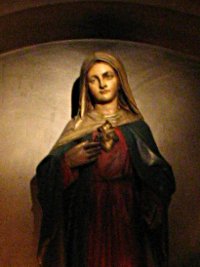
Hail Mary

Hail Mary

Holy Mary, Our Lady, Blessed Mother, Queen of Peace and at least 75 other titles reflect the deep devotion Catholics hold for the Mother of God. We do not worship her, but we do venerate her (as we do all the Saints) and ask for her intercession.

What makes her so special? Many, many things. Unlike the first Eve, she said “yes” to God – responding to the Archangel Gabriel “Behold, I am the handmaid of the Lord. May it be done to me according to your word.” (Luke 1:38). She put her trust in the Lord when the safe move was “no.”

Mary said “yes” by her own free will. God, timeless and omnipotent, knew she would and filled her with divine grace from the moment of her conception. Mary was free of the stain of original sin (Immaculate Conception) preparing her to be the vessel, the tabernacle, of Our Lord.

Jesus was then born of the Virgin Mary, having been conceived by the Holy Spirit. Mary was not only a virgin then but throughout her life (ever virgin). Jesus may have had cousins (Aramaic had no word for cousin, using the same word as brother) and it is also possible that He had step-brothers. No Holy Scripture reference is correctly interpreted however, to mean that Mary had biological children.

Having carried the Holy Infant from conception to birth, Mary was His mother. Jesus was both fully human and fully divine, both natures simultaneously. Mary was therefore the Mother of God. This Catholic dogma is sometimes misunderstood. Rest assured, Catholics do not believe that Mary created God. It is wrong however, to suggest that Mary was only the mother of Jesus the man – Our Savior was never just a man!

Let no one presume to hope for the mercy of God, who dares to slight or offend God’s mother.

Saint Louis de Montfort

The woman chosen by God Himself to be the mother of Our Lord never displeased Him. She was the model of perfect obedience to God in a challenging life tested by suffering. Upon the completion of her earthly life, Mary was assumed body and soul into heavenly glory.

Holy Mary is the new Eve to Our Lord’s new Adam. She is not only the Mother of God but the Mother of the Church.

Mary’s motherhood is defined as “eminent and singular,” since it represents a unique and unrepeatable fact: Mary, before carrying out her motherly role for humanity, is the Mother of the only begotten Son of God made man. On the other hand, the Church is a mother because she gives spiritual birth to Christ in the faithful, thus carrying out her maternal role for the members of the Mystical Body.

In this way the Blessed Virgin is a superior model for the Church, precisely because of the uniqueness of her prerogative as Mother of God.

Pope John Paul II

This brief (and incomplete) overview of Mariology brings me to the Hail Mary, said often by millions of Catholics. The Hail Mary is said so often that we are in danger of doing so mechanically. One Hail Mary well said fills the heart of Our Lady with delight and obtains for us indescribably great graces. One Hail Mary well said gives us more graces than a thousand thoughtlessly said.

Hail Mary, full of grace. The Lord is with thee.
Blessed art thou among women,
and blessed is the fruit of thy womb, Jesus.
Holy Mary, Mother of God,
pray for us sinners, now and at the hour of our death.
Amen.

Elsewhere: Mark Shea on Sola Scriptura

Elsewhere

A few weeks ago I wrote on the Protestant notion of Sola Scriptura (by scripture alone). Recently, Mark Shea wrote a piece for Catholic Exchange on the same subject.

One basic rule of thumb to understand in Catholic / Protestant conversations is that it is not the case that Catholics rely on Sacred Tradition and Protestants don’t. Rather, Catholics (and, by this, I mean “educated Catholics speaking out of the Magisterial teaching of the Church”) rely on Sacred Tradition and know they do, while Protestants rely on (parts) of Sacred Tradition and (usually) don’t know they do.

So, for instance, despite Paul’s prescriptions (directed only at clergy of his day) that a man must be the husband of but one wife, nowhere in the text of Scripture is it made clear that Christian marriage must be monogamous for all (a fact that did not escape Luther or John Milton). Nowhere does Scripture spell out or that the Holy Spirit is a person, much less the Third Person of the Blessed Trinity, consubstantial with the Father and the Son. Similarly, you will look in vain for instructions in Scripture on how to contract a valid marriage (unless you buy this list of “Top 10 Ways to Find a Wife, According to the Bible”):

10. Find an attractive prisoner of war, bring her home, shave her head, trim her nails, and give her new clothes. Then she’s yours. – (Deuteronomy 21:11-13)

9. Find a prostitute and marry her. – (Hosea 1:1-3)

8. Find a man with seven daughters, and impress him by watering his flock. – Moses (Exodus 2:16-21)

7. Purchase a piece of property, and get a woman as part of the deal. – Boaz (Ruth 4:5-10)

6. Go to a party and hide. When the women come out to dance, grab one and carry her off to be your wife. – Benjaminites (Judges 21:19-25)

5. Have God create a wife for you while you sleep. – Adam (Genesis 2:19-24)

4. Kill any husband and take his wife. – David (2 Samuel 11)

3. Cut 200 foreskins off of your future father-in-law’s enemies and get his daughter for a wife – David (I Samuel 18:27)

2. Even if no one is out there, just wander around a bit and you’ll definitely find someone. – Cain (Genesis 4:16-17)

1. Don’t be so picky. Make up for quality with quantity. – Solomon (1 Kings 11:1-3)

…which doesn’t really help much. The fact is, the Bible says “Marriage is good” but gives us not one word of instruction on how to do it. That’s because Scripture is not and never was intended to be the Big Book of Everything. And yet, of course, Protestants all over the world get married, believe in God the Holy Spirit, and have but one spouse because, as James Dobson says, God’s plan is one man and one woman. How do they do this when Scripture is so unclear?

Read the whole article: The Semi-Permeable Membranes of the Various Protestantisms

Married priests

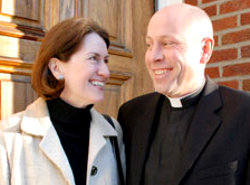
Father Tom McMichael and his wife Karin

Last week I wrote about the idea of Women Priests (bottom line: could never happen). This week’s topic is married priests. That is a totally different kettle of fish!

Priest celibacy is a matter of discipline whereas the male priesthood is a matter of doctrine. The requirement for priestly celibacy has changed over time and could change again. It is completely permissible for faithful Catholics to discuss the pros and cons of it and to respectfully hold personal viewpoints which differ from the current practice.

There is a lot of discussion among the laity on this topic. In fact, we have married priests right now. Some Eastern Catholic Churches allow married men to become priests. In those cases they may not remarry if their wife dies and only unmarried men may be ordained bishops.

Latin Rite Catholics also have married priests. This is done via papal dispensation only for married priests converting from Anglicanism and similar situations. One of the many blogs I closely follow is by Father Dwight Longenecker, an Anglican priest convert. The purpose of these dispensations is not to generally introduce non-celibate priests, but as one-time actions to heal schisms. The recently announced Anglican Ordinariate makes use of this.

While there are some married priests as described above, it is a rarity among the 410,000 priests worldwide (40,000 in the US). I don’t know of any situation permitting a married bishop.

A vow of celibacy was not always required. It is generally believed that all the Apostles other than John were married. This is not really that surprising if you consider the time and circumstances. It is also possible that some Apostles may have left their families (see Luke 18:28-30).

Later as the early Church formed, celibacy became the norm. Paul was not married. In his letter to the Corinthians he said:

I should like you to be free of anxieties. An unmarried man is anxious about the things of the Lord, how he may please the Lord. But a married man is anxious about the things of the world, how he may please his wife, and he is divided.

I am telling you this for your own benefit, not to impose a restraint upon you, but for the sake of propriety and adherence to the Lord without distraction.

So then, the one who marries his virgin does well; the one who does not marry her will do better.

Further back, Jesus – the one true High Priest – spoke of celibacy as a gift:

He answered, “Not all can accept [this] word, but only those to whom that is granted. Some are incapable of marriage because they were born so; some, because they were made so by others; some, because they have renounced marriage for the sake of the kingdom of heaven. Whoever can accept this ought to accept it.”

Celibacy was the norm in the early Church. In 305 it was explicitly addressed by the Council of Elvira (and again in 390 by the Council of Carthage).

Should priests now be allowed to marry? Some reasons given are: it would reduce the priest shortage, it would reduce temptations for priests to take scandalous actions and it would help priests be better counselors for the vocation of marriage. These are of course, “practical” not theological reasons. In my opinion, they are all false. Anglicans priests may be married and they have a similar shortage. It has been shown that celibacy has very little to do with the sex scandal. There are many areas in which people teach, coach or counsel but they themselves are not practitioners.

Looking only at the practical issues, I would say the biggest obstacle to married priests is that they simply do not have the time for a family. Were they to make the time necessary, they would have far less time for the work of the Church. More married priests would be necessary to accomplish the same service of fewer celibate priests.

Another practical issue that can not be avoided is cost. Not just because more would be needed than the equivalent celibate priests, but because their families would have to be supported. Certainly this can be done, but it would necessarily take money away from other important work.

To me the most important reason for celibacy is holiness. Our priests are 100% dedicated to the work of the Church. Their commitment and self-denial disciplines their body and spirit. We are deeply blessed to have these men who have answered their call to this vocation.

Finally, there is the vocation of deacon. They may be ordained if married (but may not marry or remarry once ordained). They too are a great blessing, may perform many of the functions of priests and also have a rigorous education. The one *big* difference is that they do not act in persona Christi consecrating the Eucharist or absolving sins (see Omnium in Mentem).

I have to admit that before I was Catholic, my thinking on priest celibacy was different. Now that I have a much better (yet far from complete) understanding of the vocations, sacraments and Church history I see this differently. If you feel so inclined, leave your thoughts in the comments.

7 Quick Takes Friday (set #6)

7 Quick Takes Friday

Some random thoughts or bits of information are worthy of sharing but don’t warrant their own full post. This idea was started by Jennifer Fulwiler at Conversion Diary to address this blogging need. So, some Fridays I too participate when I have accumulated 7 worthy items. Without further ado:

— 1 —

I have this idea for a new project – to visit all the Catholic Churches in my area for daily Mass, one per week (schedule permitting). I checked MassTimes.org looking for those within a 20 mile driving distance. There are 40, including a Cathedral, a Shrine and a (minor) Basilica! On second thought, I am redefining the project to visit the 10 closest ones over the summer with the others possibly later.

One interesting thing I also noticed is that within this set of churches, Mass is available in Latin plus Creole, Haitian, Indonesian, Korean, Nigerian, Polish, Portuguese, Spanish and Ukrainian. Sign language is available. Also represented are Byzantine, Melkite, Maronite and Greek Catholic. Wow!

— 2 —

Sometimes I go to an afternoon / early evening Mass. When it is time to greet each other, more often than not, I will say “good morning.” Is it just me, or does this happen to other people?

— 3 —

I have just discovered this beautiful video from gloria.tv. By “discovered” I mean “found it featured aspect at Kathleen’s Catholic.” If you have not yet discovered Kathleen’s blog, be sure to visit it too.

— 4 —

Sometimes guardian angels act in very real, very physical ways. Read this story about a US Marine who was saved in Korea by Saint Michael.

— 5 —

How do we get people to use their seat belts? Blood and gore is one approach. A full explanation of the risks with supporting statistics is another. Then there is this approach from the UK:

— 6 —

A return to orthodoxy, at last! In several ways this has already began. Look for more over the next decade or so. From last weekend:

The Church too must use the shepherd’s rod. The rod with which he protects the Faith against those who falsify it, against currents which lead the flock astray.

The use of the rod can actually be a service of love. Today we can see that it has nothing to do with love when conduct unworthy of the priestly life is tolerated.

Nor does it have to do with love if heresy is allowed to spread and the Faith twisted and chipped away, as if it were something that we ourselves had invented.

Pope Benedict XVI

— 7 —

Hailey Rosary

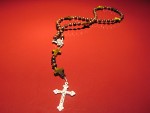
Need an affordable, beautiful Rosary for yourself or as a gift? Hailey, a friend from my RCIA class, makes them by hand and offers them online. She has setup an online store called Beads of Heaven.


show